
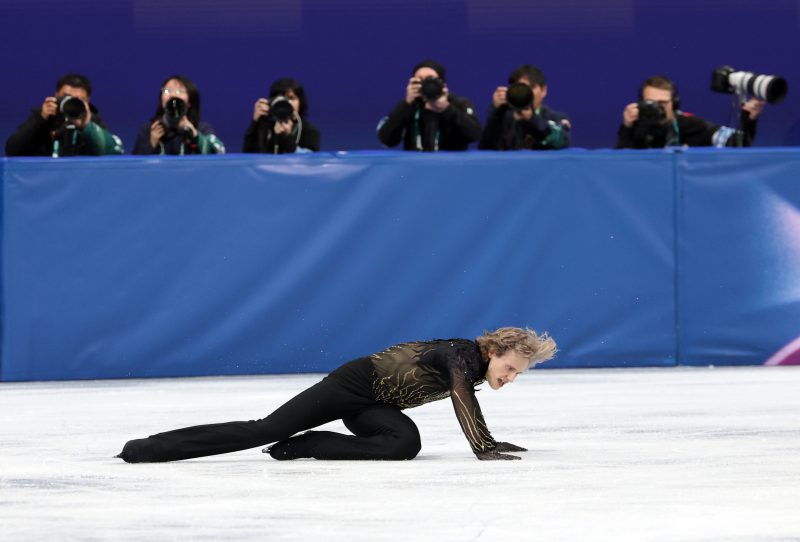
MILAN — An Olympic gold was in sight for the ‘Quad God.’ After his short program, something catastrophic would have had to happen for Ilia Malinin not to medal.
And that’s exactly what happened.
Malinin fell twice and did not fully complete other elements of his typically unbeatable routine, finishing the men’s singles event at the 2026 Winter Olympics with a total score of 264.49 for eighth place overall.
Mikhail Shaidorov (Kazakhstan) won the gold medal with a 291.58 total score, and Malinin congratulated him after. Silver and bronze went to a pair of skaters from Japan Yuma Kagiyama (280.06) and Shun Sato (274.90).
‘I blew it,’ Malinin said on the broadcast after the event. ‘That’s honestly the first thing that came to my mind, there’s no way that just happened. I was preparing the whole season, I felt so confident with my programs, so confident with everything. That happened. I have no words, honestly.’
Watch Ilia Malinin Olympics video on Peacock
The 21-year-old Malinin sat in first place — by a comfortable margin of five points — entering the free skate, but was among the many skaters who struggled to stay upright on the ice on Friday, Feb. 13 in Milan.
‘I felt really good this whole day, going really solid, and I just thought that I all I needed to do was go out there and trust the process that I’ve always been doing with every competition,’ he said. ‘But of course, it’s not like any other competitions, it’s the Olympics.”
What happened to Ilia Malinin?
The 21-year-old scored a 156.33 in his disastrous free skate, finishing in eighth place with a total score of 264.49. It’s the first event he’s lost since November 2023, and the first time he didn’t finish in the top three at a competition since March 2022. He didn’t land a single quad Axel the entire competition.
‘I was not expecting that. I felt like going into this competition, I was so ready,’ he said. ‘I just felt ready getting on the ice, but I think maybe that have been the reason that maybe I was too confident that I was (going to) go well. It honestly just happened. I can’t process what just happened. It happens.’
‘I think it was definitely mental. Just now experiencing that Olympic atmosphere, it’s crazy. It’s not like any other competition. It’s really different.’
Breaking down Ilia Malinin’s free skate, jump by jump
Here’s a breakdown of every element from Ilia Malinin’s free skate program, looking at what was planned and what actually happened.
Ilia Malinin free skate video
NBC broadcasts the Olympics and has replays of every event on TV, Peacock and the full video of Malinin’s routine is already on YouTube.
Ilia Malinin 8th place finish
Malinin finished in eight place finish in the men’s singles figure skating competition at the Olympics. It’s the first event he’s lost since November 2023, and the first time he didn’t finish in the top three at a competition since March 2022.
What Ilia Malinin said on hot mic
As Ilia Malinin sat in the Kiss-and-Cry section, waiting for his free skate score to be read out after his terrible performance at the 2026 Winter Olympics, he was caught on a hot mic talking about how things would have been different had he gone to the 2022 Beijing Games.
‘Beijing, I would not have skated like that,’ he was heard saying. Then, NBC commentator Johnny Weir told viewers what he said: That he would not have skated so terribly had he already had Olympic experience under his belt.
Malinin could be heard saying: ‘It’s not easy.’ The 21-year-old was later asked about the comment.
‘I think if I went to ’22, then I would have had more experience and know how to handle this Olympic environment,’ he said. ‘But also, I don’t know what the next stages of my life would look like if I went there.’
Mikhail Shaidorov wins figure skating gold
Ilia Malinin congratulates Mikhail Shaidorov
Men’s singles figure skating results
- Mikhail Shaidorov (Kazakhstan): 291.58 total score, 198.64 free skate, 92.94 short program.
- Yuma Kagiyama (Japan): 280.06 total score, 176.99 free skate, 103.07 short program.
- Shun Sato (Japan): 274.90 total score, 186.20 free skate, 88.70 short program.
- Junhwan Cha (Korea): 273.92 total score, 181.20 free skate, 92.72 short program.
- Stephen Gogolev (Canada): 273.79 total score, 186.37 free skate, 87.42 short program.
- Petr Gumennik (Neutral Athlete): 271.21 total score, 184.49 free skate, 86.72 short program.
- Adam Siao Him Fa (France): 269.27 total score, 166.72 free skate, 102.55 short program.
- Ilia Malinin (United States): 264.49 total score, 156.33 free skate, 108.16 short program.
- Daniel Grassl (Italy):263.71 total score, 170.25 free skate, 93.46 short program.
- Nika Egadze (Georgia): 260.27 total score, 175.16 free skate, 85.11 short program.
- Kevin Aymoz (France): 259.94 total score, 167.30 free skate, 92.64 short program.
- Andrew Torgashev (United States): 259.06 total score, 170.12 free skate, 88.94 short program.
- Kao Miura (Japan): 246.88 total score, 170.11 free skate, 76.77 short program.
- Lukas Britschigi (Switzerland): 246.64 total score, 165.77 free skate, 80.87 short program.
- Matteo Rizzo (Italy): 243.18 total score, 158.88 free skate, 84.30 short program.
- Aleksandr Selevko (Estonia): 236.82 total score, 154.80 free skate, 82.02 short program.
- Boyang Jin (China): 229.08 total score, 142.53 free skate, 86.55 short program.
- Deniss Vasiljevs (Latvia): 226.46 total score, 144.02 free skate, 82.44 short program.
- Kyrylo Marsak (Ukraine): 224.17 total score, 137.28 free skate, 86.89 short program.
- Maxim Naumov (United States): 223.36 total score, 137.71 free skate, 85.65 short program.
- Vladimir Samoilov (Poland): 222.25 total score, 144.68 free skate, 77.57 short program.
- Donovan Carrillo (Mexico): 219.06 total score, 143.50 free skate, 75.56 short program.
- Yu-Hsiang Li (Chinese Taipei): 214.33 total score, 141.92 free skate, 72.41 short program.
- Adam Hagara (Slovakia): 202.38 total score, 122.08 free skate, 80.30 short program.
Simone Biles stops by figure skating
Eleven-time Olympic medalist and seven-time Olympic gold medalist Simone Biles stopped by the Milano Ice Skating Arena on Friday night to watch ‘Quad God’ Ilia Malinin and the rest of the men’s singles figure skaters compete for Olympic hardware.
Maxim Naumov’s free skate
Despite the mixed performance, the crowd shared its love for the skater. He even earned a standing ovation from actor Jeff Goldblum, who is in the crowd at Milano Ice Skating Arena. He again shared the photo of him as a child with his parents.
Here’s more about his backstory:
After Naumov finished in fourth place at the 2025 U.S. figure skating championships for the third straight year, his father, Vadim, wanted to game plan.
Vadim and Maxim’s mother, Evgenia Shishkova, were two-time Olympic pair skaters for Russia, and they knew Maxim’s upcoming year was critical with the 2026 Winter Olympics on the horizon.
A few days later, Vadim and Shishkova were among the 67 people killed in the midair collision between American Airlines Flight 5342 and an Army helicopter near Washington, D.C. They were among the 28 figure skating coaches, young athletes and parents who were returning from a development camp. An unimaginable tragedy, and Naumov didn’t know if he could skate anymore.
Read the full story from reporter Jordan Mendoza.
Why is Ilia Malinin called the ‘Quad God’?
Simply put, Ilia Malinin has the greatest array of jumps any figure skater in history has ever possessed. He’s launched himself into the air for seven quadruple jumps in a single long program at last month’s Grand Prix Final and was the first skater to land a quad Axel.
Malinin’s username used to be Lutz God, but he changed it to Quad God after landing his first quad jump.
“i didn’t think much about it … Days go by and people started asking, ‘Why’d you name yourself Quad God, you only landed one jump,’’ he said on Milan Magic, USA TODAY’s new Olympics podcast that drops its first episode Saturday. ‘And then I was like, ‘Oh, OK maybe I should be come a Quad God.’ From there I found my rhythm of landing quad after quad after quad and then of course landing the first quad axel.”
“In the most humble way possible, I think it’s definitely helped my confidence in not only to skating in general but just feeling like I deserve to be recognized as who I am.”
What makes Ilia Malinin so great? Skaters marveled by the ‘Quad God’
These are the few ways to describe Ilia Malinin, and none of them are an exaggeration. Every sport gets an athlete that redefines everything you know about it. Basketball had Michael Jordan. Football had Tom Brady. Baseball has Shohei Ohtani.
Now, figure skating has its phenom, and it’s not just fans that are amazed by the 21-year-old. Those who have championed the sport and been through the grind are just as flabbergasted by how he’s turned figure skating upside down.
‘All the skaters that I sit with in the audience, they throw up their hands, and they think, ‘Oh, my God, this guy’s just so amazing,’” 1988 Olympic champion Brian Boitano said on USA TODAY’s Milan Magic podcast.
Now, the entire world has its chance to be the next spectators wowed at the 2026 Winter Olympics. It’s been a journey four years in the making, and in his Olympic debut, Malinin is out to show why he is the present and future of figure skating.
He already did it in the team event, and now it’s time for him to do it in the men’s singles to become the next great American figure skating champion.
Figure skating Olympics schedule
Here is the remaining figure skating schedule in Milan. All times Eastern.
- Feb. 15, 1:45 p.m.: Pairs short program
- Feb. 16, 2 p.m.: Pairs free skate
- Feb. 17, 12:45 p.m.: Women’s short program
- Feb. 19, 1 p.m.: Women’s free skate
Ilia Malinin’s parents
Malinin was born into figure skating. His mother, Tatiana Malinina, is from the Soviet Union, Siberia specifically, and competed at 10 consecutive world figure skating championships for Uzbekistan. She finished eighth at the 1998 Winter Olympics in Nagano, the competition in which Tara Lipinski won the gold medal and Michelle Kwan the silver. Malinina finished fourth at the 1999 world championships as well, and she also competed at the 2002 Salt Lake City Olympics, but withdrew after the short program with the flu.
Malinin’s father, Roman Skorniakov, represented Uzbekistan at the same two Olympics, 1998 and 2002, finishing 19th both times. He and Malinina were married in 2000 and became skating coaches in the United States, moving to the Northern Virginia suburbs of Washington, D.C., where, in December 2004, Ilia was born. He took the Russian masculine form of his mother’s last name because his parents were concerned that Skorniakov was too difficult to pronounce.
Are backflips allowed in figure skating?
They are now. For nearly 50 years, the backflip was banned in figure skating, after American skater Terry Kubicka became the first one to execute it at the 1976 Innsbruck Games. French skater Surya Bonaly did it at the 1998 Winter Olympics, landing it on one blade, but the move was illegal and she was deducted for it.
The International Skating Union reversed course and made the move legal in 2024, paving the way for it to be done at the 2026 Winter Olympics, 50 years after it was first done.
Ilia Malinin backflip
The ‘Quad God’ performed his first skate during the team event Saturday, Feb. 7, and he became the first skater since 1998 to perform a backflip at the Games, and the first since it was unbanned.
Malinin closed his performance with the stunning move than wowed the crowd at the Milano Ice Skating Arena. However, Malinin finished second in the event with a score of 98.00 after Japan’s Yuma Kagiyama pulled off a stunning routine that received 108.67 points.
Malinin then landed a backflip on one foot during his long program of the team event. Malinin was the first to pull off the one-foot move since French figure skater Surya Bonaly at the 1998 Nagano Winter Games. Bonaly landed it on one blade despite it being banned at the time and was deducted for it.
Quad axel in figure skating
Malinin is the only skater in history to achieve a quadruple axel in competition. That feat earned him the nickname ‘Quad God.’
What is a quad axel though? Here’s a full explanation of Malinin’s iconic move. A quadruple axel requires four-and-a-half rotations in order to complete. It’s so difficult, in fact, that it was once considered impossible to perform.
When did figure skating start in the Olympics?
Figure skating first made its Olympic debut at the Summer Games in London in 1908 and made another appearance in Antwerp in 1920, before becoming a Winter Olympic staple at the inaugural 1924 Chamonix Winter Games with men’s singles, women’s singles and pair skating events. Ice dancing was added to the program at the 1976 Innsbruck Winter Olympics, and the team event was first contested at the 2014 Sochi Winter Olympics.
How is figure skating scored?
A figure skating routine is made up of two scores: Technical elements score and program components score. The technical elements score is exactly what it sounds like: It’s for the jumps, spins and step sequences in a performance. The program components score is made of up composition, presentation and skating skills.